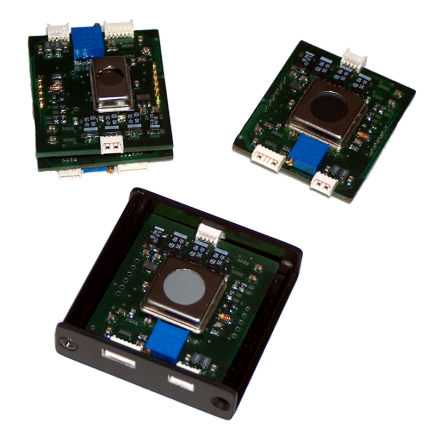
The OEM modules of the EMK series offer laser manufacturers simple and cost-effective integration of the PEO series sensors into their own laser systems without major development effort.
The basic EMK100 model supplies a corresponding analogue voltage for each laser pulse, which can be easily read in via the laser control unit. Additional connection contacts for power supply, measurement and trigger signals allow the module to be plugged into its own circuit boards, thus reducing the amount of cabling required.
Significantly higher repetition rates are possible with the EMK200. The power supply has also been simplified and the output signal is made available on an SMA socket to reduce interference. Power and trigger signals can be connected either via a 9-pin D-Sub connector or a simple wire-to-board connector. The trigger signal is coupled in and the measuring range is switched via optocouplers.
With the EMK200, the measured values reach the laser controller via USB without having to take the diversions via an analogue signal. Power is also supplied via USB. The communication protocol is kept very simple to facilitate integration into your own software. Labview examples can be provided. The firmware supports two modes. In ‘Stream’ mode, every recorded energy value is transmitted via the interface. In ‘Statistics’ mode, only all relevant statistical values are recorded over an adjustable number of pulses and only these are transmitted.
All versions have 2 measuring ranges. The analogue versions are switched via a 5V signal, the USB version via software.
Optional housings are available for all versions. Required mounting holes can be discussed.
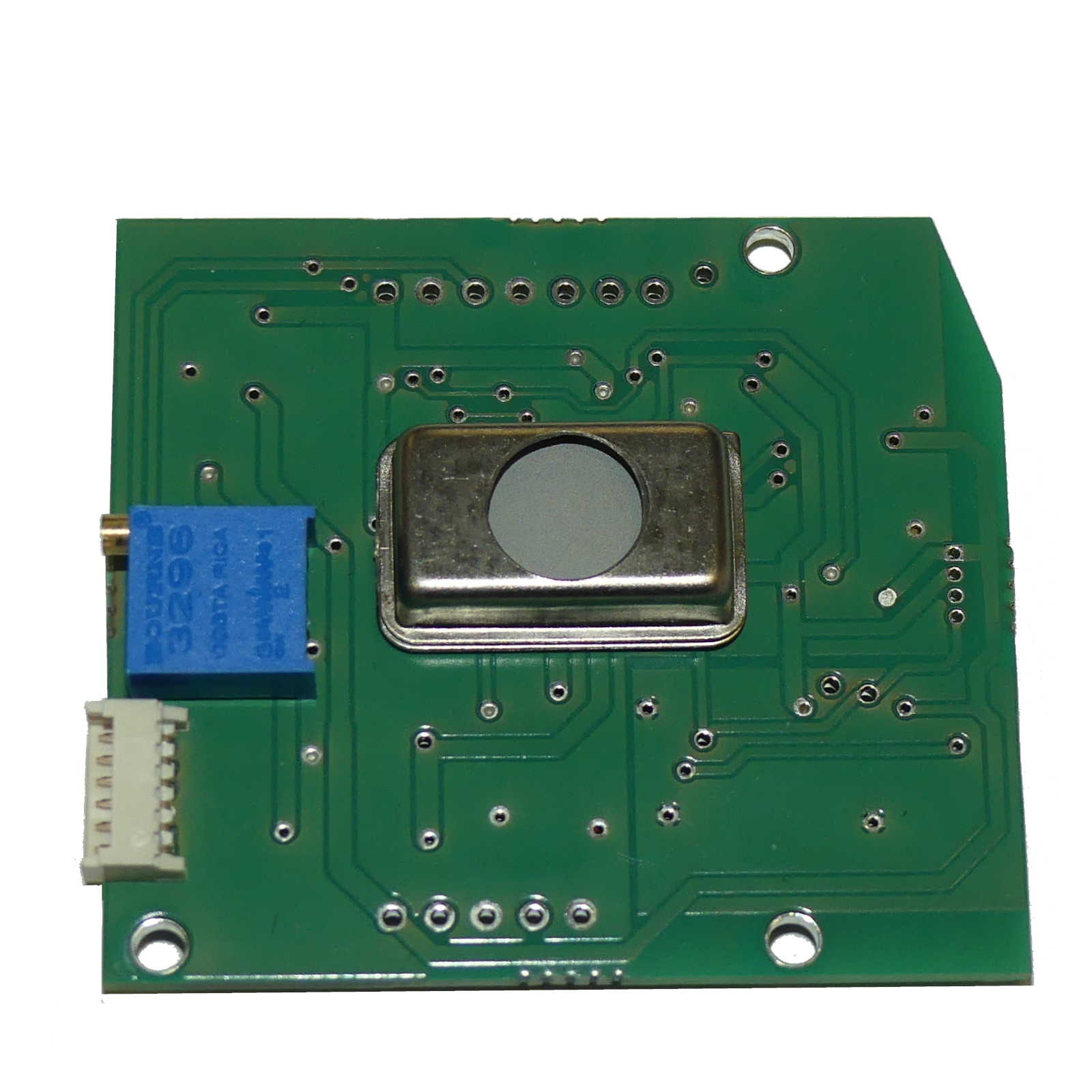
The base board also has slots for the PEO series sensors. When using sensors with an integrated preamplifier, it is also possible to mount the sensor and evaluation separately. For this purpose, the base board has a plug connector for connecting the sensor.
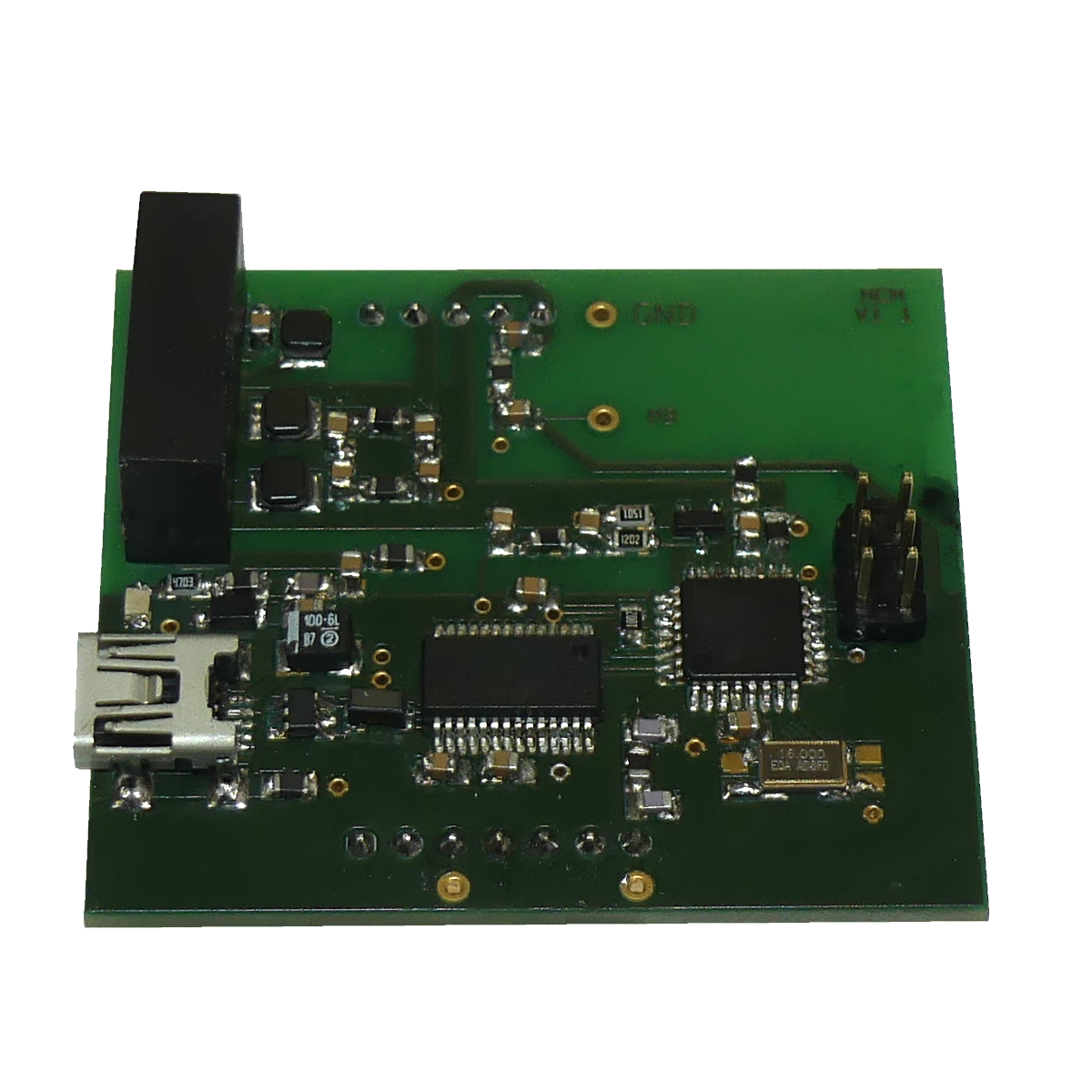
The MCM module connects the EMK 100 to a USB port (mini-USB connection). The module powers itself and the EMK 100 via the USB port and also controls the preamplifier. A simple ASCII protocol is used for communication between the PC and the MCM. The maximum pulse repetition rate is over 1 kHz.
The basic EMK100 model supplies a corresponding analogue voltage for each laser pulse, which can be easily read in via the laser control unit. Additional connection contacts for power supply, measurement and trigger signals allow the module to be plugged into its own circuit boards, thus reducing the amount of cabling required.
Significantly higher repetition rates are possible with the EMK200. The power supply has also been simplified and the output signal is made available on an SMA socket to reduce interference. Power and trigger signals can be connected either via a 9-pin D-Sub connector or a simple wire-to-board connector. The trigger signal is coupled in and the measuring range is switched via optocouplers.
With the EMK200, the measured values reach the laser controller via USB without having to take the diversions via an analogue signal. Power is also supplied via USB. The communication protocol is kept very simple to facilitate integration into your own software. Labview examples can be provided. The firmware supports two modes. In ‘Stream’ mode, every recorded energy value is transmitted via the interface. In ‘Statistics’ mode, only all relevant statistical values are recorded over an adjustable number of pulses and only these are transmitted.
All versions have 2 measuring ranges. The analogue versions are switched via a 5V signal, the USB version via software.
Optional housings are available for all versions. Required mounting holes can be discussed.
The base board also has slots for the PEO series sensors. When using sensors with an integrated preamplifier, it is also possible to mount the sensor and evaluation separately. For this purpose, the base board has a plug connector for connecting the sensor.
The MCM module connects the EMK 100 to a USB port (mini-USB connection). The module powers itself and the EMK 100 via the USB port and also controls the preamplifier. A simple ASCII protocol is used for communication between the PC and the MCM. The maximum pulse repetition rate is over 1 kHz.